
Ground Screw as Reliable Foundation for Container Homes
With the rapid development of modular construction, shipping container houses have become a mainstream solution for temporary construction camps, remote site offices, residential tiny homes, disaster relief shelters, and commercial container buildings. Compared with traditional brick and concrete structures, container houses feature fast assembly, flexible relocation, and low material waste. However, one critical challenge that frequently confuses project developers and general contractors is foundation selection. Traditional concrete slab foundations require extensive earthwork, long curing periods, and leave permanent land modifications, which greatly reduces the flexibility and environmental advantages of modular container buildings. Under this industry pain point, ground screw foundations have gradually become a highly recognized alternative. Many overseas engineering clients repeatedly consult whether ground screws can fully replace concrete foundations for container house projects and what technical limitations need to be controlled. In fact, ground screw systems are completely applicable for container house foundations, but they require standardized geotechnical assessment, customized structural layout, and strict construction control to ensure long term structural stability.
To judge the feasibility of ground screw foundations for container houses, it is necessary to first clarify the load characteristics of container structures, which are essentially different from conventional solar bracket loads. Solar ground screw systems mainly bear static vertical dead loads and regular wind induced vibration loads. In contrast, container houses bear composite multi directional forces throughout their service life. Each standard shipping container has a self weight of several tons, and additional loads come from interior decoration, furniture, personnel activities, and roof snow accumulation in winter. More importantly, container buildings are highly susceptible to horizontal wind shear force and wind uplift force. In coastal and open field areas, strong winds can generate tremendous pulling pressure on the container frame. If the foundation lacks sufficient horizontal stiffness and anti uplift capacity, the entire building will experience displacement, frame deformation, or even overall overturning risks. This is why container ground screw design is more comprehensive and rigorous than ordinary solar foundation design.
Site soil condition assessment is the primary prerequisite for adopting ground screw container foundations. Not all construction sites are suitable for screw piles installation. Firm and stable soil layers including compacted loam, dense clay, gravelly soil, and weathered bedrock are the most ideal foundation conditions. These soil types provide reliable friction resistance and end bearing force for ground screws, effectively resisting vertical compression and horizontal displacement of container buildings. On the contrary, special weak soil environments require strict risk evaluation. Deep loose fill soil, newly reclaimed land, saturated soft mud, and highly organic peat soil have extremely low bearing capacity and poor soil compactness. Installing screw piles in these areas will lead to insufficient friction grip, causing uneven foundation settlement after the container is put into use. In addition, sites with high groundwater levels also need special attention. Long term soil saturation will reduce soil shear strength and may accelerate metal corrosion, requiring optimized coating solutions and deeper burial depth during design.
Scientific ground screw layout and quantity calculation are the core guarantees of container foundation stability. Many failed container foundation cases are caused by unreasonable pile arrangement rather than unqualified ground screw quality. Standard container houses adopt a frame force bearing structure, and the stress is mainly concentrated on the four corner castings and the bottom side rails. Therefore, ground screw piles cannot be arranged randomly. The conventional professional layout is to set independent ground screw supporting points under the four corners of the container, and add auxiliary support piles in the middle of the longer side rails for larger or multi story container buildings. Engineers calculate the required screw diameter, blade configuration, embedded depth and total quantity according to geotechnical test reports, local wind speed, snow load and container dead and live loads. Cutting down the number of ground screws blindly to reduce project cost is a common mistake. Insufficient supporting points easily trigger uneven settlement, which can bend the container steel frame, jam the container doors, and create cracks on wall panels.
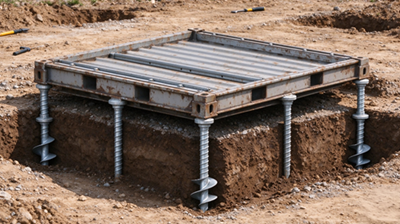
There are clear differences in design standards between temporary container structures and permanent container residences. Temporary container buildings, such as construction site offices and short term field camps with service life less than five years, can adopt standard ground screw specifications under qualified soil conditions. The safety factor can be set according to temporary building codes, balancing performance and budget. For permanent container homes that serve as long term residential buildings, higher design requirements must be implemented. Designers need to increase the safety factor of bearing capacity, select thicker steel tubes, and upgrade corrosion resistant coatings. Extra checks for long term soil creep are also necessary, to prevent slow settlement over decades of use. Local building codes and permit requirements must be checked in advance, as some regions have special regulatory requirements for permanent modular building foundations.
Ground screw foundations bring prominent practical advantages to container house projects. Installation requires no concrete pouring, no concrete curing cycle and minimal soil excavation work. A single standard container foundation can often be finished within one working day with proper equipment and experienced crews. This greatly shortens the whole project schedule compared with concrete foundations. When the project reaches the end of its service life, ground screws can be fully extracted from the soil. The land can be restored to its original state without permanent concrete waste, complying with land protection and environmental regulations in many countries. For remote construction sites with inconvenient transportation of concrete raw materials, ground screws also reduce logistics difficulties.
Even with obvious benefits, ground screw foundations for container houses have non negotiable limitations. Steep slopes, unstable sliding soil layers or extremely soft mud usually make ground screws uneconomical or unsafe. Frost sensitive areas need the screw tip to be installed below the local frost line. Frost heave generated by frozen soil expansion will lift the foundation and damage the container structure if the penetration depth is insufficient. High corrosion zones such as coastal salt spray sites also demand upgraded surface protection. Ordinary hot dip coating can meet most project demands. For these aggressive high corrosion environments, we can produce ground screws with thicker hot dip coating to extend service life.
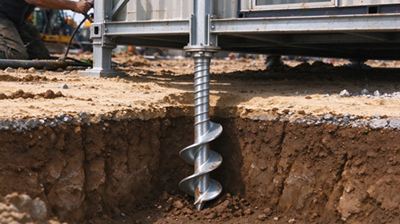
Strict on site construction quality control cannot be ignored during installation. Operators need to monitor the driving torque continuously while screwing screw piles into the ground. Torque value reflects the friction between ground screw and surrounding soil. If the torque is lower than the calculated target value at the designed depth, it indicates poor soil bearing capacity, and engineers need to adjust pile depth or reselect installation positions. Verticality inspection is another essential step. Excessive tilt of ground screws reduces lateral load resistance and creates hidden safety hazards. After all ground screws are installed, a visual inspection and spot check should be carried out before placing the container, to confirm that all supporting points are at the same elevation and meet design specifications.
Proper maintenance after installation helps extend the service life of ground screw container foundations. Visual inspection can be arranged annually, focusing on checking surface coating integrity, foundation displacement signs and abnormal gaps between container frame and ground screws. For projects in corrosive environments, more frequent inspection intervals are recommended. Timely handling of coating scratches and rust spots can stop corrosion from spreading. When planning to relocate the container building, professional teams can remove screw piles for reuse after checking structural integrity, which improves the overall economic value of the foundation system.


Leave a Reply
Want to join the discussion?Feel free to contribute!