
Ground Screw Installation Mistakes And Their Consequences
Choosing the correct installation method is critical to ensure long-term stability of ground screw foundations. Even high-quality ground screws may fail to deliver designed bearing capacity if installed improperly. Many installers with limited experience tend to skip standard site checks or operate machines without following technical specifications. Small errors during installation can gradually develop into hidden structural risks, which may only be discovered months or years after project completion. Understanding common ground screw installation mistakes, their negative impacts and preventive measures helps contractors reduce site failures and protect the safety of upper structures supported by screw piles.
One of the most frequent mistakes is installing ground screws with excessive tilt. Ground screws are designed to transfer vertical and limited lateral loads along their central axis. When the shaft deviates from vertical direction beyond allowable tolerance, stress will concentrate on part of the helical blades and steel shaft. Under continuous load, the tilted ground screws are more likely to bend or lose holding force. For most engineering projects, vertical deviation should be controlled within 2 percent. Installers should check vertical status constantly during penetration instead of only measuring after the whole ground screw is driven into soil.
Insufficient installation depth is another widespread problem. Some workers stop driving ground screws once they feel slight resistance, without reaching the required design depth. The helical blades need to enter stable bearing soil layers to gain enough pull-out and compression resistance. If ground screws stay in loose topsoil, seasonal changes including rainfall and frost movement will greatly reduce their stability. This mistake often appears on tight schedule projects, where teams rush to finish installation and ignore geotechnical report requirements. The consequence is settlement or upward movement of the foundation, damaging fences, solar frames and lightweight buildings on top.
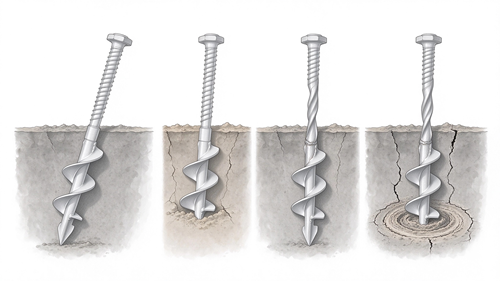
Over-torquing ground screws also creates serious hidden dangers. Operators may keep applying high torque even after ground screws reach target depth, thinking higher torque means better stability. Extra twisting force can crack weld joints between helical blades and steel shaft, or deform the shaft structure. Damaged ground screws may look intact on the surface, but their mechanical strength drops sharply. When external loads act on it later, blade separation or shaft fracture can occur suddenly. Installers should match the machine torque setting with project design parameters and stop operation once reaching preset depth and torque value.
Disturbing surrounding soil around ground screws is often underestimated by field teams. When ground screws rotate into soil, it rearranges soil particles nearby. Repeated rotation back and forth or repeated re-driving at the same spot will loosen the surrounding soil mass. Loose soil cannot provide reliable friction and bearing support for screw piles. This problem is more obvious in soft clay and sandy ground. Once soil strength drops, the holding capacity of ground screws will decrease significantly. Workers should avoid reversing the ground screws unnecessarily during installation.
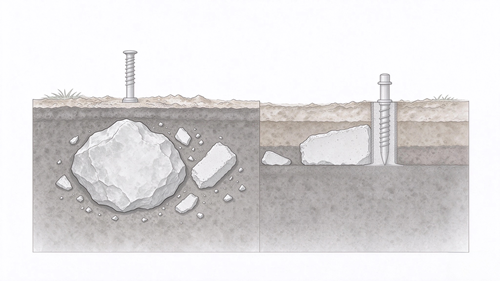
Failure to clear underground obstacles before installation leads to many unexpected site accidents. Rocks, old concrete fragments and buried pipes can block ground screw penetration. If installers force the ground screws to rotate against hard obstacles, the helical blades may be worn down or broken. In the worst cases, underground utility lines get damaged and cause safety hazards. Site survey and obstacle detection should be completed before any ground screw placement. If large rocks exist at target depth, adjust the position of ground screws or adopt special customized products for rocky sites.
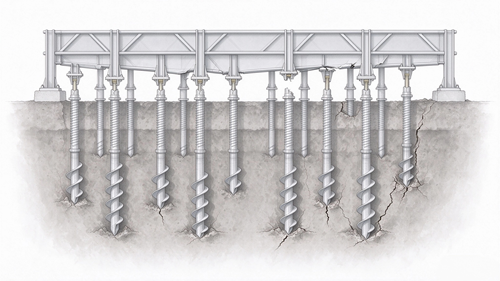
Poor alignment of multiple ground screw units in one foundation group affects the whole foundation system. For projects with several ground screws working together, inconsistent elevation among individual screw piles will create uneven load distribution. Some ground screws will bear more weight than calculated, while others take less load. Overloaded ground screws will deform faster under long term pressure. Installers need to control the final height of each ground screw accurately, adjust the top connection plate to keep the same elevation before fixing upper structures.
Ignoring soil seasonal changes during installation planning is a common design oversight. Some installers complete ground screw installation in dry summer when soil is hard, but do not consider soil expansion in rainy seasons or frost heave in cold areas. Expansive soil can push ground screws upward when absorbing water. Frozen soil in cold regions creates upward force on screw piles. Without proper depth and anti-heave design, ground screws will shift vertically with seasonal soil movement. Engineers should refer to local soil data and set installation depth below active frost or moisture change layer.
Improper connection between ground screw top bracket and upper structure also counts as a typical installation error. Many people assume that simply placing the structure on the bracket is enough. Loose bolts or mismatched bracket size will create gaps between ground screws and supported structure. Vibration from wind or daily use will loosen the connection further. The upper structure will shift slowly, and the load cannot transfer evenly down to ground screws. All bolted connections must be tightened according to specified torque, and bracket specifications should match the base size of the above structure.
Lack of on-site record and inspection after installation is an easily ignored mistake. Many teams finish driving all ground screws and leave the site without recording depth, torque and verticality data. When problems emerge later, there is no valid data to trace the installation quality. Complete site records help identify defective ground screws in time. Field inspectors should randomly check finished screw piles, record key parameters and mark units that fail to meet requirements for rework before upper construction starts.
To avoid these installation mistakes, standardized operation processes and regular worker training are essential. Site supervisors should carry out pre-installation briefing, review geotechnical reports and confirm design parameters with installation crews. Regular tool calibration is also necessary, to guarantee torque measuring devices and leveling tools give accurate readings. Investing time in proper site preparation and careful installation can greatly reduce foundation failure risks and extend the service life of ground screw foundations.
With clear awareness of these typical installation errors and their potential risks, project owners, engineers and field installers can establish robust on-site quality control protocols. Ground screws can deliver their economic and eco-friendly advantages only when installed in full compliance with professional engineering specifications. Careful construction practices help screw piles maintain consistent long-term performance and secure the structural safety of various above-ground installations.


Leave a Reply
Want to join the discussion?Feel free to contribute!