
Ground Screw Corrosion Assessment in Coastal Areas
Coastal projects are among the most challenging working environments for ground screw foundations. High salinity in soil and persistent airborne salt spray creates an extremely aggressive corrosive environment that significantly accelerates metal material degradation and coating failure. Unlike ordinary inland construction sites, coastal regions carry two major long-term corrosion sources: chloride ions continuously carried by sea wind and salt substances accumulated in the underground soil and groundwater. Even high-quality carbon steel substrates with standard anti-corrosion treatment will gradually suffer surface rust and internal oxidation if protective coatings are damaged or fail, which greatly reduces the long-term bearing performance and stability and shortens the overall service life of ground screws. Before confirming final foundation solutions, professional project designers must carry out comprehensive corrosion assessment based on detailed local environmental parameters and actual site conditions.
The first and most critical step of corrosion assessment is systematic site soil testing and groundwater analysis. Professional engineers collect sufficient soil samples at different depth layers to accurately measure salt content, chloride concentration, pH value and soil resistivity. High chloride concentration has always been the core indicator for judging coastal corrosion risk levels. Areas close to the shoreline usually have extremely high salt accumulation, and the overall corrosion risk gradually decreases as the distance from the coastline increases. It is also necessary to fully investigate groundwater fluctuation and water quality conditions. When the local groundwater is highly saline, the ground screw will be repeatedly immersed in corrosive liquid with the seasonal rise and fall of the water table, greatly speeding up coating abrasion, metal oxidation and structural corrosion. Tidal zones and low-lying coastal land are particularly risky, as frequent water immersion creates continuous electrochemical corrosion that far exceeds normal inland corrosion rates.
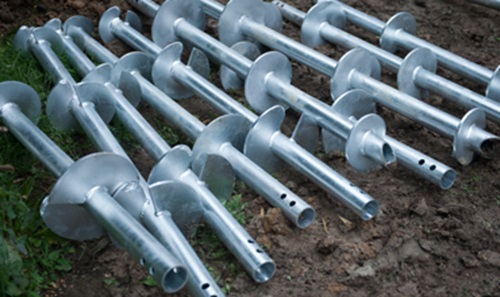
Salt spray from ocean winds brings additional long-term corrosion risks to above-ground pile sections. The exposed parts of installed ground screws are directly and continuously exposed to humid and salty sea mist throughout the year. Fine salt particles continuously deposit on the smooth metal surface and easily absorb moisture from humid coastal air, forming a stable electrolyte film. This long-term electrochemical reaction slowly erodes and consumes the protective zinc layer over years of operation. Local wind direction, annual humidity and regional rainfall also directly affect the overall corrosion speed. Heavy seasonal rain can wash away surface salt deposits to some degree and relieve corrosion pressure, while coastal areas with frequent sea fog and high humidity see much faster coating aging and metal deterioration.
Scientific coating selection is the absolute core part of corrosion protection for coastal ground screw installations. Hot dip galvanizing remains the most widely adopted and cost-effective anti-corrosion solution for solar and infrastructure projects. However, the standard galvanized thickness designed for common inland projects is often completely insufficient for harsh coastal salt environments. Higher and customized zinc coating thickness is strictly required to effectively resist chloride erosion and extend the long-term service life in high-corrosion coastal zones. Some high-standard long-life projects adopt additional topcoat layers or duplex coating systems on galvanized surfaces to form double-layer anti-corrosion protection.
It is extremely important to note that tiny scratches, abrasions or coating damages generated during transportation, stacking, handling and installation become the weakest points where corrosion begins to spread rapidly. Even small scratches that look harmless at first will become corrosion starting points once exposed to coastal chloride environments. Any minor damage to the zinc layer cannot be ignored during site acceptance, as coastal corrosive media can penetrate the steel substrate through these gaps. Localized rust products expand in volume, gradually bulging and peeling off the surrounding zinc coating, eventually forming large-scale corrosion areas.
Standardized construction and careful pile handling effectively help preserve the complete integrity of anti-corrosion coatings on each ground screw. Professional construction teams must avoid violent heavy impacts, sharp friction and forced extrusion that may scratch or damage the outer zinc layer. Any minor or major coating damage found on site inspection must be fully repaired with professional approved touch-up materials before formal installation. After all ground screws are completely driven into the designed position, site inspectors need to carefully check all exposed sections for coating defects, peeling and scratches. On-site cutting and welding operations should be minimized as much as possible, because high-temperature heat-affected zones will completely lose the original factory anti-corrosion performance and require strict professional re-treatment and secondary protection.
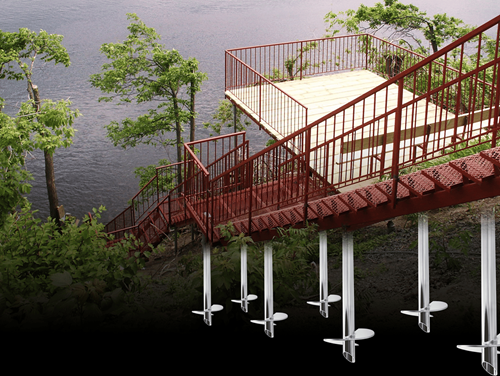
Regular periodic inspection and long-term corrosion monitoring cannot be ignored for large-scale coastal photovoltaic and foundation projects. Routine detailed site visits and quality checks are strongly recommended every 1 to 2 years after project completion and official operation. Professional inspectors comprehensively check for coating peeling, surface rust spots, color fading and obvious signs of metal loss. For large utility-scale solar projects with a design life over 20 years, continuous long-term corrosion monitoring helps construction and operation teams discover early degradation problems in advance. Timely targeted maintenance effectively prevents small-scale corrosion issues from expanding into serious structural safety hazards that affect the stability of the entire solar support and fencing system.
Many project owners and engineering clients often wonder about the actual service life differences between inland and coastal ground screw installations. With reasonable customized anti-corrosion coating configuration and strict on-site construction quality control, ground screw foundations can still fully meet the standard design lifespan and stable load performance in complex coastal zones. In contrast, without professional corrosion assessment and targeted anti-corrosion protection measures, even thickened metal steel sections may suffer premature aging, rusting and structural failure. Coastal corrosive environments do not simply wear the surface; they gradually reduce the effective steel cross-section, lowering tensile and bearing capacity over time.
Scientific corrosion assessment is not an optional extra procedure but an indispensable core part of foundation design for all coastal projects that adopt ground screw foundation systems. Every coastal ground screw project should start with environmental investigation and corrosion risk evaluation to select the most suitable materials and protection plans. Standardized assessment and protection measures ensure long-term foundation safety, reduce later maintenance costs, and maximize the return of investment for coastal solar and civil infrastructure projects.


Leave a Reply
Want to join the discussion?Feel free to contribute!